
The workforce behind Texas’s next wave of investment
Issue 14 · October 29, 2026 · 6 min read
First-job access, practical training and routes back into work.
Read the original LinkedIn edition ↗
Workforce Intelligence Brief | October 29, 2026
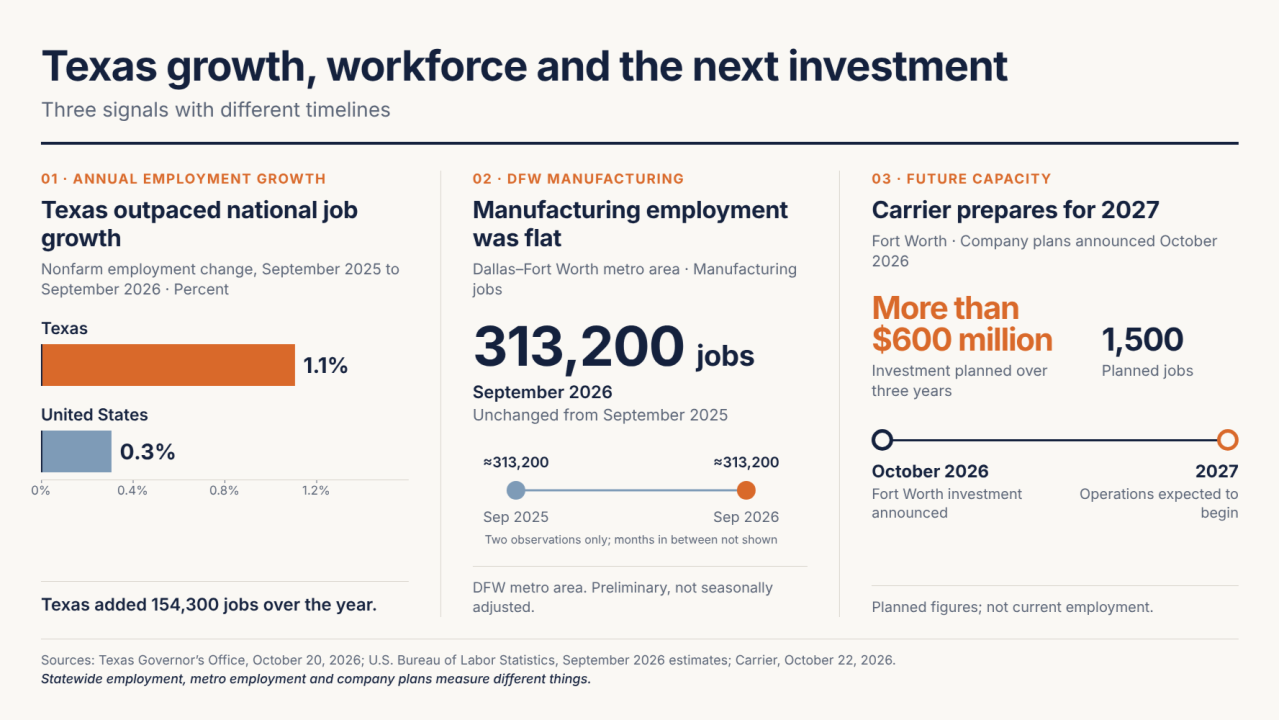
Texas added 154,300 nonfarm jobs over the year to September, growing 1.1% compared with 0.3% nationally. Yet preliminary, not seasonally adjusted estimates put DFW manufacturing employment at approximately 313,200, unchanged from a year earlier. [1, 5]
Now Carrier plans to invest more than $600 million in Fort Worth, with 1,500 planned jobs and operations expected in 2027. [4]
Those figures describe different geographies and timelines, but they raise a useful question: how does a region prepare for the next employer while helping people enter the workforce it already has?
This week’s research points to three places to look: first-job access, the capacity to teach practical skills and adults whose previous learning could shorten their route back into work.
The missing first job
Stanford’s Canaries in the Coal Mine study used ADP payroll data through June 2026 to examine employment by age and occupational exposure to AI.
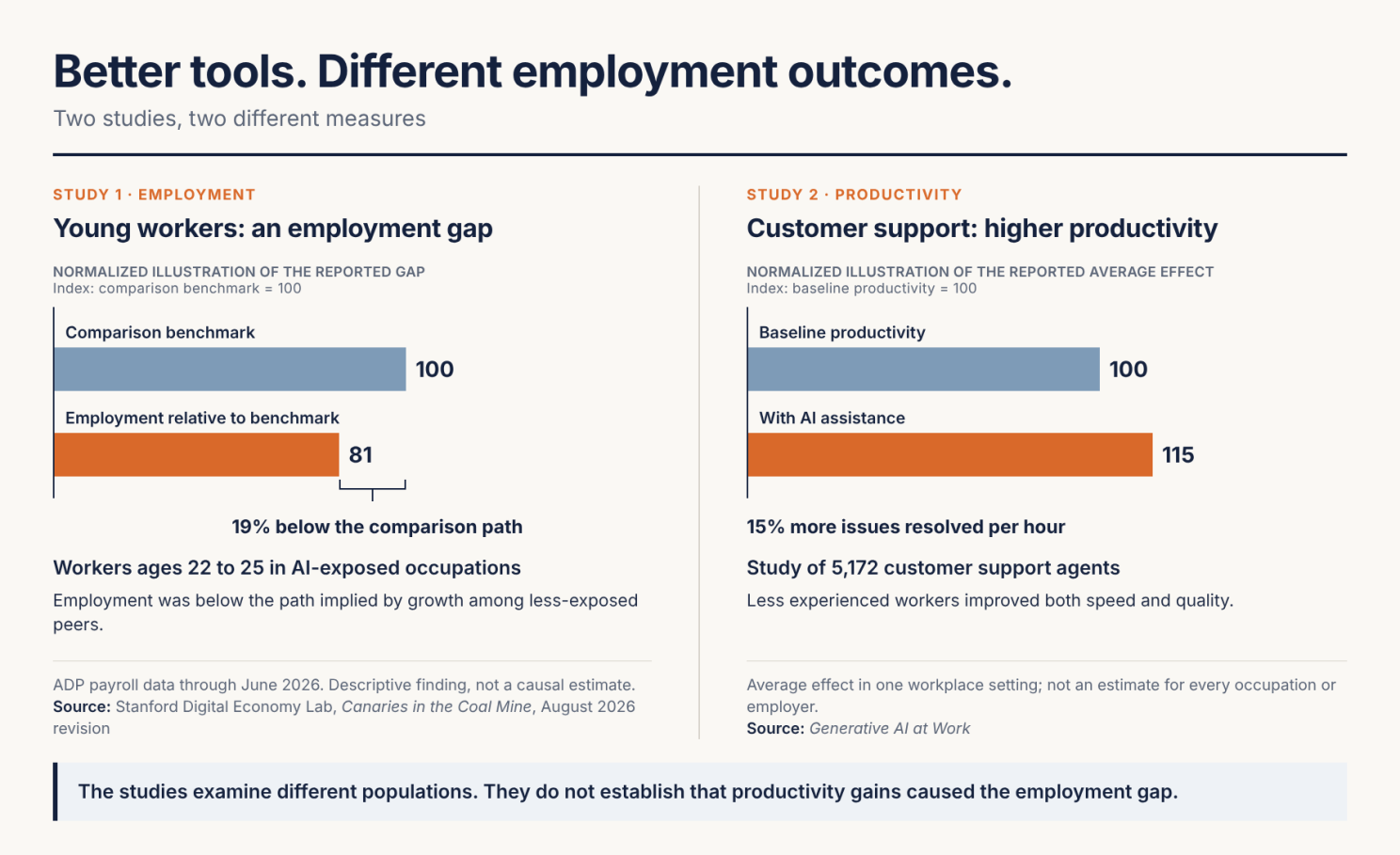
Employment among workers ages 22 to 25 in AI-exposed occupations stood 19% below the path implied by keeping pace with less-exposed peers. The divergence came primarily through reduced hiring, rather than increased separations. These are descriptive findings, not causal estimates, and the authors found no widespread economy-wide displacement. [2]
A missing first job is less visible than a layoff. It can still change who gets the chance to build experience.
A separate study of 5,172 customer support agents found that AI assistance increased issues resolved per hour by 15% on average. Less experienced workers improved both speed and quality. That result comes from one workplace setting, not the whole economy. [3]
These studies do not establish that productivity gains caused the hiring gap. They do show why better tools and better access to work need to be examined separately. Faster learning is valuable, but someone still needs an opportunity to use it.
Digital growth needs physical production
Carrier’s planned Fort Worth center will produce commercial chillers for data centers, healthcare, education and industrial markets. Its investment is planned over three years. [4]
The connection is concrete: digital infrastructure needs cooling equipment, and that equipment needs people who can build, test and maintain it.
That does not mean someone facing weaker office hiring can move straight into manufacturing. Safety requirements, technical preparation and location can make it a very different transition.
For workforce planning, the next step is to identify the roles, hiring dates and entry requirements. Which jobs require prior experience, and which can an employer help someone learn? That distinction should shape recruitment and training before the facility opens.
Training begins with the employer’s work
Penny Pritzker describes a useful starting point in Harvard Business School’s Managing the Future of Work podcast. A Chicago community college and Cook County Hospital collaboration began with vacant positions and work being covered by staffing agencies. Training was tied to a problem the employer already needed to solve. [6]
Her account is a practical example, not an independent evaluation. The lesson for Texas is to begin with specific work and commitments before designing a program.
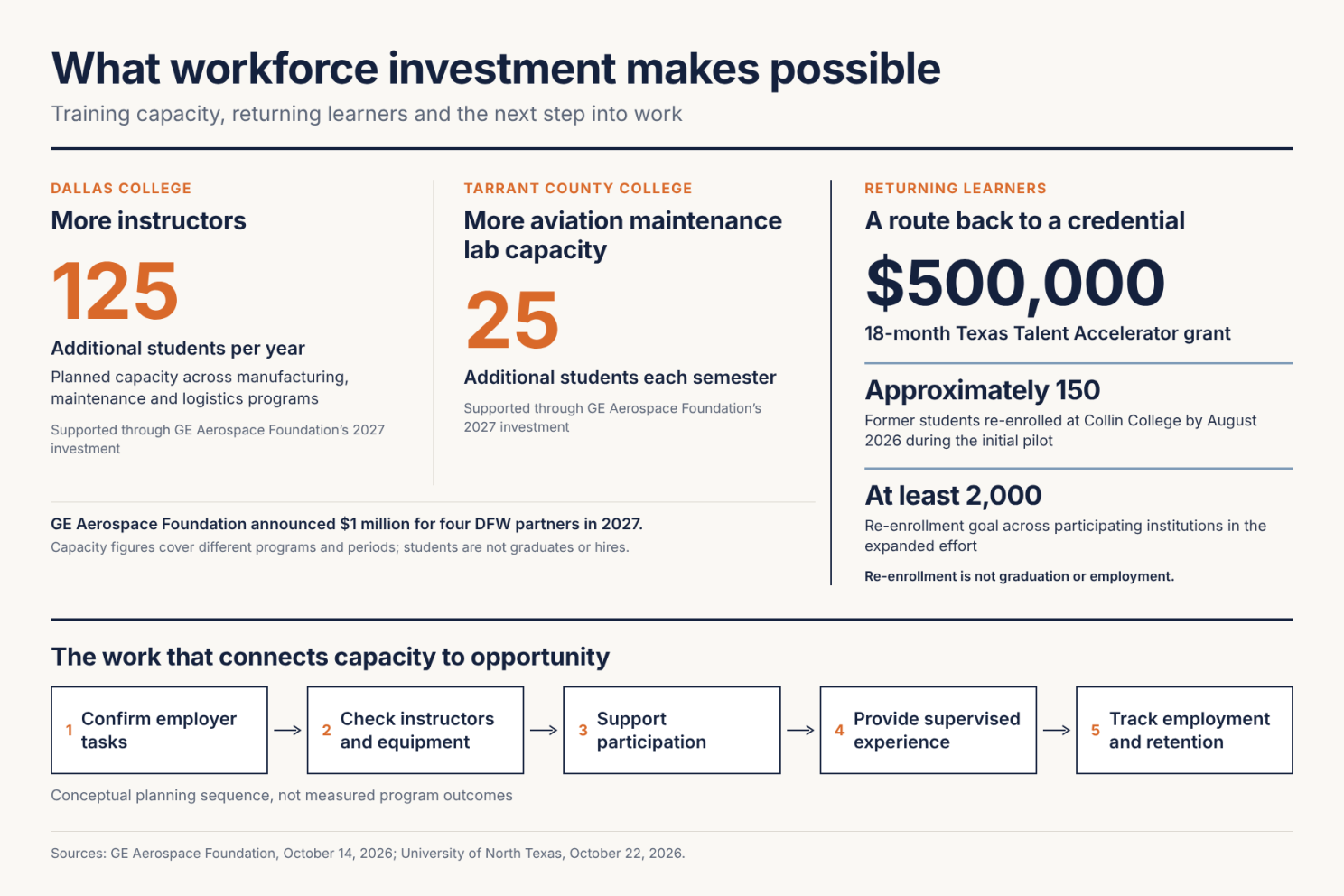
The GE Aerospace Foundation’s announced $1 million investment in four DFW partners shows what capacity-building can involve. For 2027, Dallas College plans additional instructors to reach 125 more students per year across manufacturing, maintenance and logistics. Tarrant County College plans aviation maintenance lab expansion for another 25 students each semester. [7]
Those are different programs and time periods, so the figures cannot be added into one annual talent supply or matched directly to Carrier’s jobs.
The planning questions become tangible: Is an instructor available? Is there usable lab space? Can an employer provide supervised practice? A funded seat is only useful if the rest of that route works.
Texas investment watch
Four recent milestones show why the stage of a project matters as much as its headline investment.
Houston | Life sciences | Under construction. Lilly’s $6.5 billion facility broke ground in September, with more than 600 planned operating jobs. Its $12.5 million support for San Jacinto College includes pathways requiring no prior experience. Training preparation is taking shape alongside construction. [10]
Socorro | Computing hardware | Operating and expanding. Wiwynn’s first building began shipments in late 2025. The company reports more than $1.6 billion invested and expects a second building to begin production in Q2 2027. Each phase has its own preparation timeline. [11]
Amarillo | Aerospace services | Operational. International Aerospace Coatings reported its new widebody painting hangar fully operational in October. This is growth from an established local employer, not a new arrival. [12]
Austin | Semiconductors | Opened. Silicon Labs opened its Innovation Center in September, supported in part by a $23 million state grant. The work is chip design and testing, distinct from fabrication. The grant is not the total project investment. [13]
These are selected milestones from recent months. A groundbreaking, an operating facility and a second-phase expansion call for different workforce conversations.
A shorter route back into work
MIT economist David Autor argues that technology can expand the valuable work people are capable of doing when it helps them apply expertise. [8] For adult learners, an equally practical starting point is recognizing the expertise they already have.
UNT’s $500,000 Carnegie grant supports an 18-month Texas Talent Accelerator effort to re-enroll at least 2,000 students across participating institutions. Partners will consider existing credits, work experience and career interests. [9]
That could change how much preparation someone needs to repeat. Re-enrollment is the starting measure; completion and employment will show whether the route delivers.
A useful next step is a one-page plan for one role. An employer, college and workforce board should be able to see the same requirements, preparation route and hiring date.
For the next employer conversation, I would ask four questions: What must someone be able to do on day one? What can they learn under supervision? Who has the instructors, equipment and time to prepare them? When will the employer be ready to hire?
Record who will confirm each answer and by when. Then follow the people through preparation, hiring and retention. Which role would you start with in your region?
Sushma Vadlamannati
Founder and CEO, zScale Intellect
Sources
Sources reviewed October 26, 2026.
[1] Texas Governor’s Office: September jobs update
[2] Stanford: Canaries in the Coal Mine
[3] Stanford: Generative AI at Work
[4] Carrier: Fort Worth expansion
[6] HBS: Penny Pritzker on workforce partnerships
[7] GE Aerospace Foundation: DFW workforce investment
[8] Pitchfork Economics: David Autor on work and AI
[9] UNT: Texas Talent Accelerator
[10] Lilly: Houston facility and workforce support
[11] Wiwynn: Texas manufacturing expansion