
A factory is coming. What should the region do first?
Issue 13 · October 14, 2026 · 7 min read
Connecting employer needs with regional preparation.
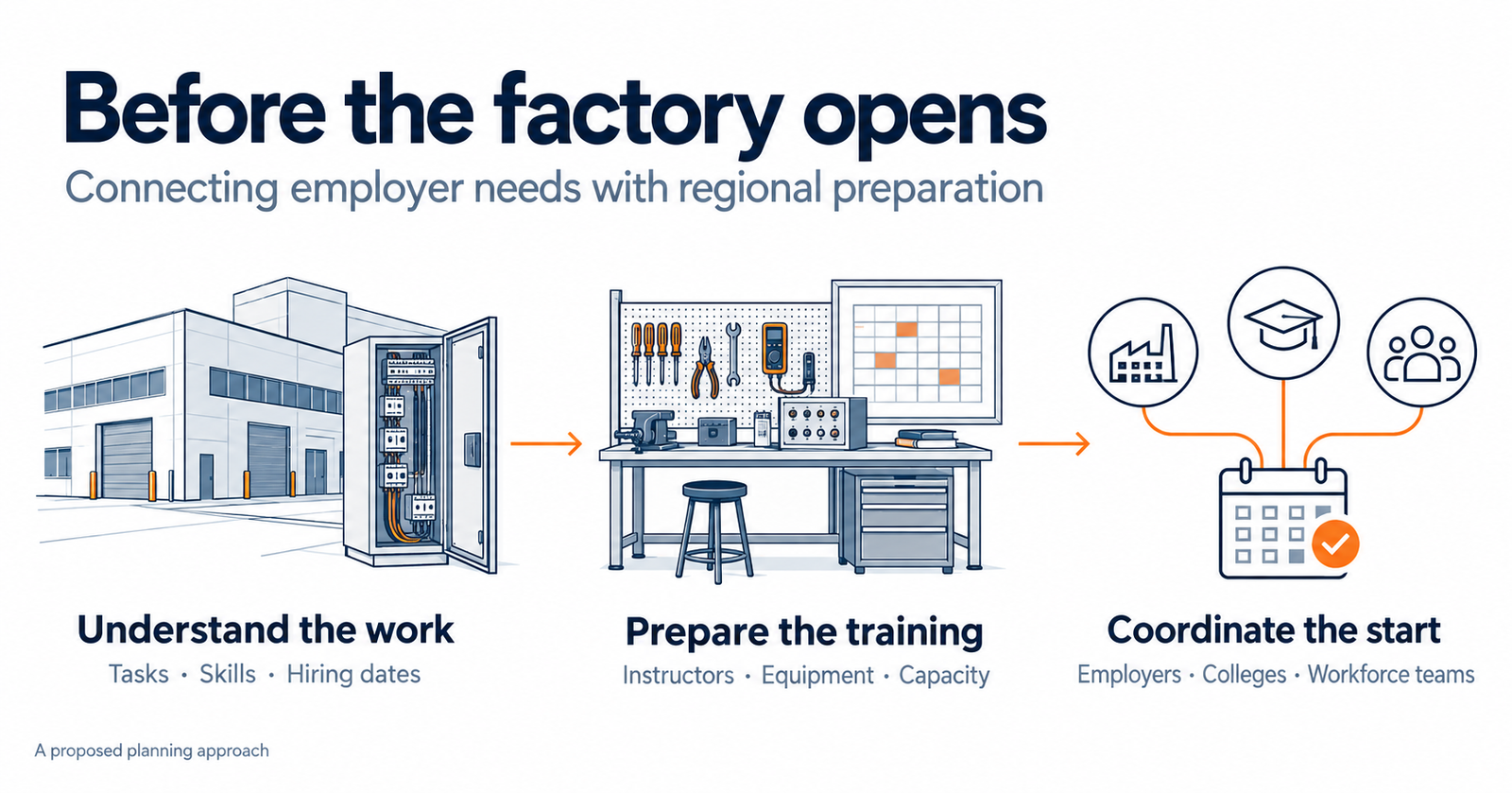
A new factory announces thousands of jobs. A college considers a training program. A workforce team begins thinking about recruitment.
Before those plans move forward, there is a question I would want everyone to answer together: what does the employer need first?
In my recent conversations with economic development, workforce and education teams, I have been learning how much the answer can change. Sometimes the next step is training. Sometimes it is a better understanding of wages, work schedules or the roles people are actually being hired to fill.
Industrial Electric Manufacturing (IEM)’s planned factory in San Antonio is a useful place to look.
On August 25, the power distribution equipment manufacturer announced a $200 million facility at Brooks. The company expects up to 3,000 jobs by 2030 across manufacturing, engineering, logistics and corporate support. The facility will be developed in phases, with construction and hiring timelines still to be announced. [1]
That last detail matters. A college deciding what to offer next semester needs a different level of detail from someone assessing the size of the investment.
Which work comes first? Who needs to be ready for it? And what can the region put in place while the project takes shape?
Understand the hiring needs
I would begin with the people responsible for production and hiring. Before discussing a new course, I would want to understand the first roles, the work those people will do and the dates the employer is working toward.
A factory may need people to install and commission equipment before it needs a full production workforce. Later, it will need people who can keep that equipment running. Those needs can overlap, but they should be planned separately.
The first useful document would be a phased hiring plan: roles, required skills, shifts, wages and likely start dates. Where details are still being decided, record who will confirm them and when.
I would also ask what the workforce board and education partners already know. Workforce Solutions for Tarrant County, for example, publicly describes candidate recruitment and job-matching support. A regional response can begin with services already available, then identify what still needs confirming. [8]
The walkthrough below is my proposed planning approach. It is not IEM’s internal hiring plan, and the local resources described here are not confirmed IEM partners.
Identify the skills
Consider an electrical assembly role. O*NET describes work that can include reading drawings and instructions, assembling components, inspecting or testing wiring and recording results. That is a starting point for an employer conversation, not a confirmed job description for the San Antonio site. [2]
An employer and instructor could review a representative assembly together. Which instructions must a new hire understand? Which tasks need supervised practice? What would demonstrate that someone can do the work correctly?
Now the resource discussion becomes concrete: practice components, appropriate tools, safe training equipment, an instructor and an employer-approved assessment. The employer also needs to set aside time for experienced staff to teach and supervise.
This is where a broad request for “manufacturing talent” becomes something a college can help deliver.
Plan training around hiring
San Antonio already has resources worth examining. Alamo Technical Institute offers customized workforce solutions. St. Philip’s College offers a five-semester Advanced Manufacturing Technology program through TXFAME, combining two days of coursework with three days of paid work each week. Its curriculum includes electrical and mechanical systems, automation and troubleshooting. [3] [4]
A pathway like that can support longer-term technical development. It cannot be assumed to supply the first production team on a shorter schedule.
For an initial hiring phase, the employer might need a different combination of experienced hires, targeted instruction and supervised training on the job. The right mix depends on the tasks and what candidates already know.
Before committing to a class, I would want the partners to confirm:
- When instructors, equipment and lab space are available.
- How many learners can be supported at the required start date.
- Which skills the college can teach and which require company-specific instruction.
- Who will supervise learning at work and how that time will be funded.
A course in a catalog is a useful lead. Available capacity for a particular employer and date still needs to be checked. So do approval deadlines, instructor availability and the time needed to adapt teaching. An employer’s hiring date and a college’s planning calendar need to meet somewhere.
Help people take part
Workforce Solutions Alamo offers recruitment assistance, labor market information and employee development services. It also helps eligible families access child care support. These are resources a regional team can investigate alongside the training plan. [5]
Class and shift times need to work for the people being recruited. Someone may be able to learn the job but unable to attend daytime training while keeping their current income. A parent may need care outside standard hours. The commute may be manageable for one shift and difficult for another.
Before calling this a skills shortage, I would check whether the offer works for the people the employer hopes to hire. If experienced candidates can earn more nearby, another training class may not solve the immediate problem. Existing employers may also be trying to retain people with the same skills.
The budget needs the same practical approach. Alamo Colleges describes a Skills Development Fund route for customized employer training. Eligibility, available funding and approval timing would need confirmation for a specific project. [6]
Instruction is one cost. Equipment access, paid learning time, assessment and employer supervision also need an owner and a budget.
What we can learn from Eaton
A related expansion in Arkansas helps explain why this is worth following beyond one city.
On September 2, Eaton announced a more than $242 million facility in North Little Rock to manufacture modular electrical enclosures. It expects more than 1,200 manufacturing, electrical and operations jobs. Its announcement explicitly includes hands-on training and opportunities for employees to move into higher-skilled roles. [7]
The two projects make related electrical infrastructure products, but they do not establish identical skill needs. Their products, production processes and hiring schedules still need to be understood separately.
What Texas readers can take from the comparison is a practical line of inquiry: as electrical equipment manufacturing expands in different regions, which skills recur, and which remain specific to an employer?
That could help colleges and workforce teams decide where shared foundational training makes sense and where customized instruction is necessary. Two announcements alone cannot tell us whether there is a regional labor shortage.
Agree on who does what
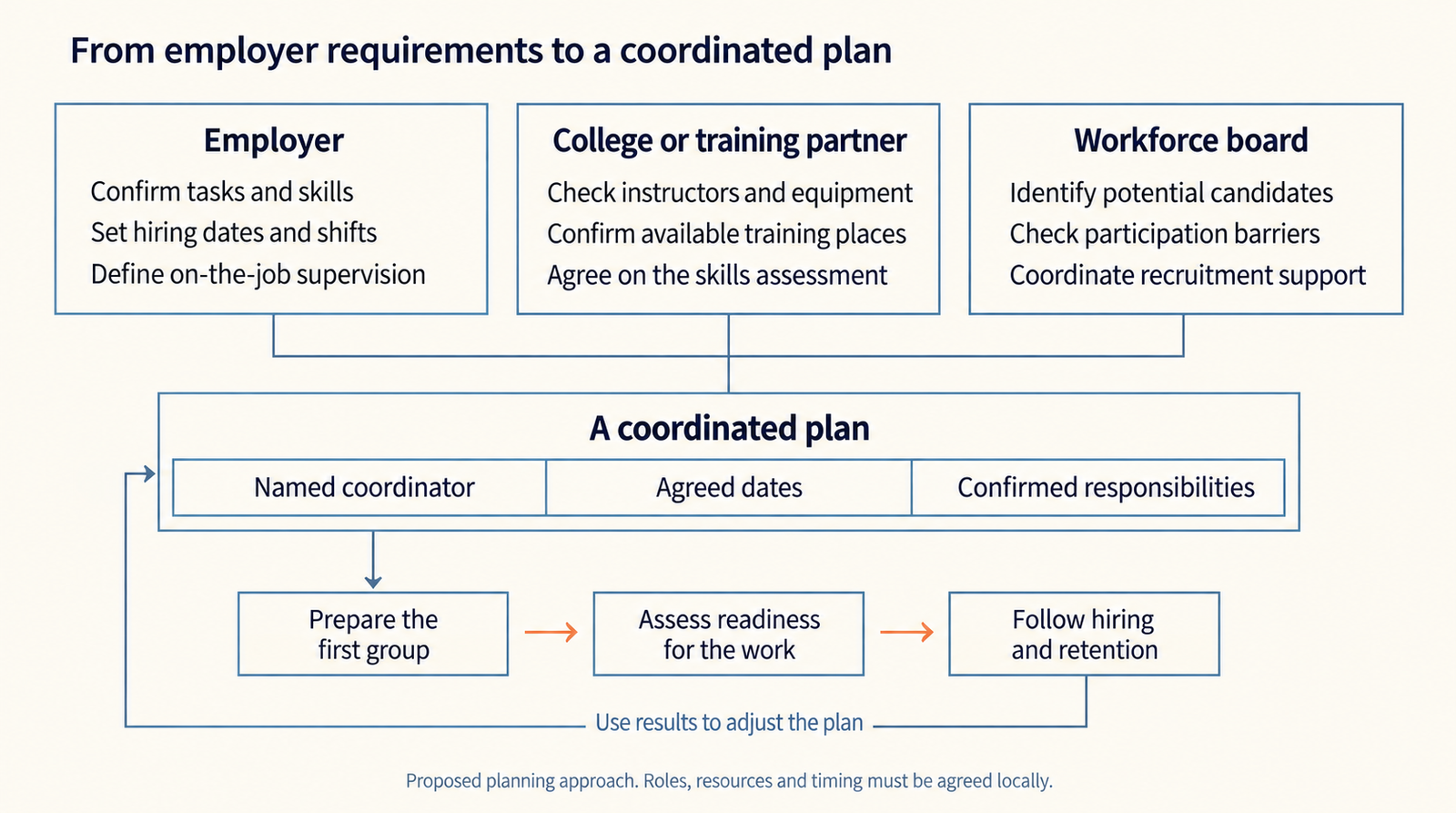
There is also a useful example beyond the factory announcements. In its public partnership with the LAUNCH Apprenticeship Network, the Bay Area Council describes its role as leading employer engagement. LAUNCH brings the apprenticeship and community-college connection. [9]
That division of work is worth considering here. Who gets the employer’s requirements? Who checks whether a training pathway fits? Who brings the unresolved questions back to the employer?
A list of organizations is useful. Knowing who will carry the next conversation forward makes it much more practical.
Start with one group
I would start with one validated role and a first group of learners that the employer and training partner can support well. Before it begins, agree on what successful preparation looks like.
Then follow what happens: who completes training, who starts work and how long it takes to perform the agreed tasks safely and competently. Track who stays and ask why people leave as carefully as why they succeed.
I would agree on those measures before the first class starts. Completing training and moving into related work are different outcomes. The partners need a practical way to follow both, with permission and a clear owner for the follow-up.
If the first group struggles, the response may be a change in instruction. It may also be a change in scheduling, supervision or the conditions of the job. More recruitment will not solve every problem.
For me, the useful output is a shared next step: the employer confirms the work, the training partner checks what it can deliver and the workforce team helps determine how people can participate. Each needs a date and someone responsible for following through.
If you work with an expanding employer, what information do you wish you had received earlier? I would be interested in the detail that changed your planning.
Further reading
The announcements and resources that informed this article are linked below. The job numbers reflect the companies’ plans for future growth. I have used these examples to explore how a region could prepare, rather than describe an agreed plan for either factory.
[1] IEM: San Antonio facility announcement, August 25, 2026
[2] O*NET: Electrical and electronic equipment assemblers
[3] Alamo Technical Institute: employer workforce solutions
[4] St. Philip’s College: Advanced Manufacturing Technology / TXFAME
[5] Workforce Solutions Alamo: employer and participant services
[6] Alamo Colleges: Skills Development Fund
[7] Eaton: North Little Rock expansion, September 2, 2026
[8] Workforce Solutions for Tarrant County: candidate recruitment
[9] Bay Area Council: partnership with LAUNCH, December 10, 2025