
Texas Industrial Growth Is Reshaping Regional Workforce Demand
Issue 10 · September 3, 2026 · 5 min read
How Texas industrial parks are changing workforce demand and why colleges and workforce boards need to join the conversation before facilities open.
Read the original LinkedIn edition ↗
Fort Worth's AllianceTexas added 2,100 jobs in six days this July. MTU Maintenance opened an aircraft engine campus and Foxlink opened an AI factory with 900 production jobs. Both landed at the same park in the same week. That is the current velocity of a single industrial park.
Texas industrial parks are creating thousands of jobs that require a different kind of training than what most four-year graduates have. For example, Hillwood, the developer behind AllianceTexas, reported in mid-2025 that 75-85% of new inquiries were for manufacturing, production and assembly space. That is a sharp pivot from the prior decade when logistics and distribution dominated.
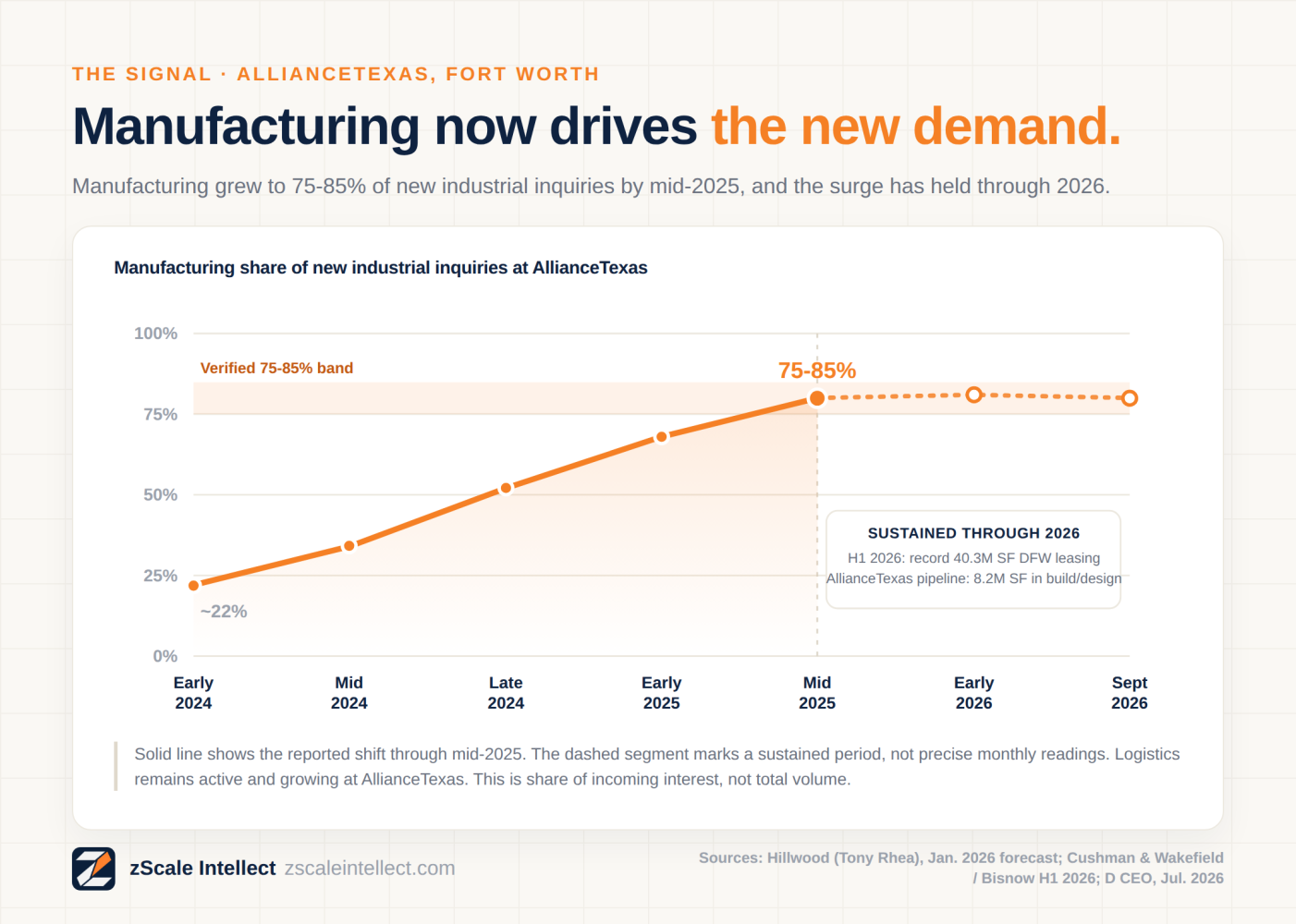
The workforce landscape in Texas is shifting rapidly. Across the state's major industrial hubs, a new hiring surge is generating thousands of skilled roles that demand specialized technical training rather than traditional four-year degrees. This edition examines where these positions are emerging and how workforce development strategies must adapt to meet demand. Logistics and distribution tenants need 1-3 jobs per acre. Manufacturing tenants need 8-15 jobs per acre of skilled technicians: electricians, mechatronics techs, CNC operators, quality inspectors and maintenance crews.
While the physical footprint remains identical, the regional workforce strategy requires a total transformation.
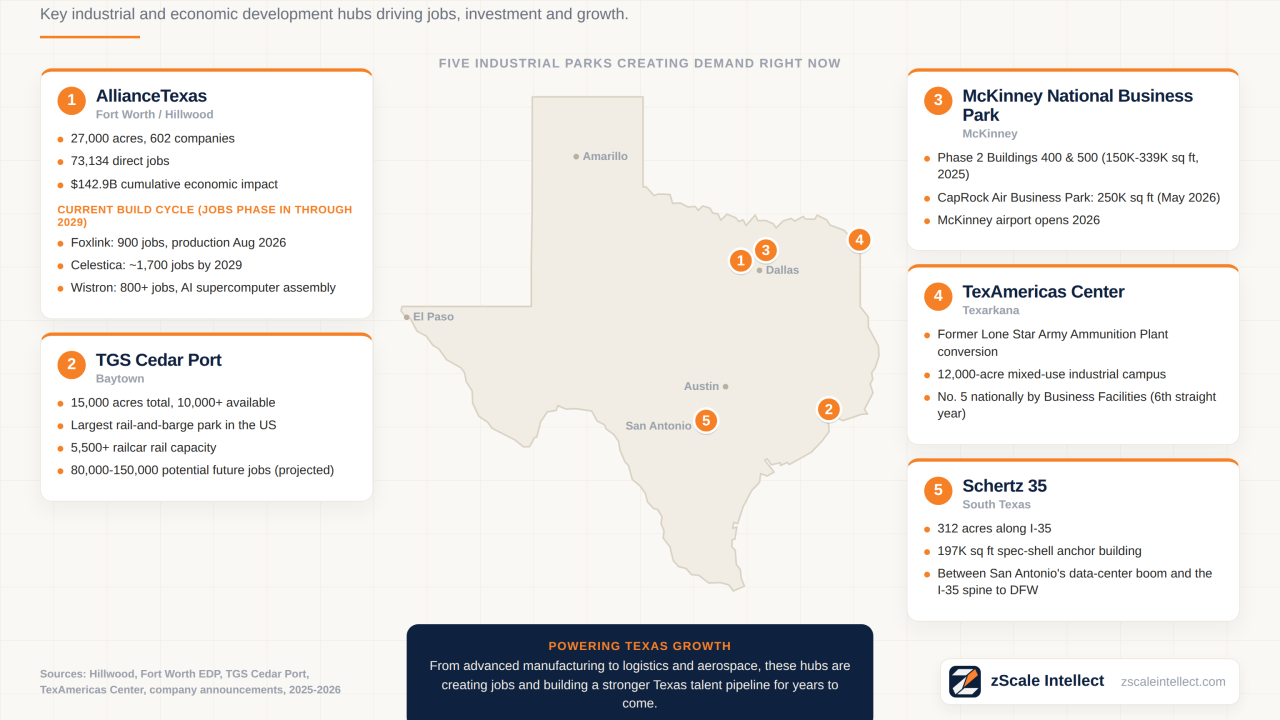
Here are the Five Texas industrial parks creating demand right now
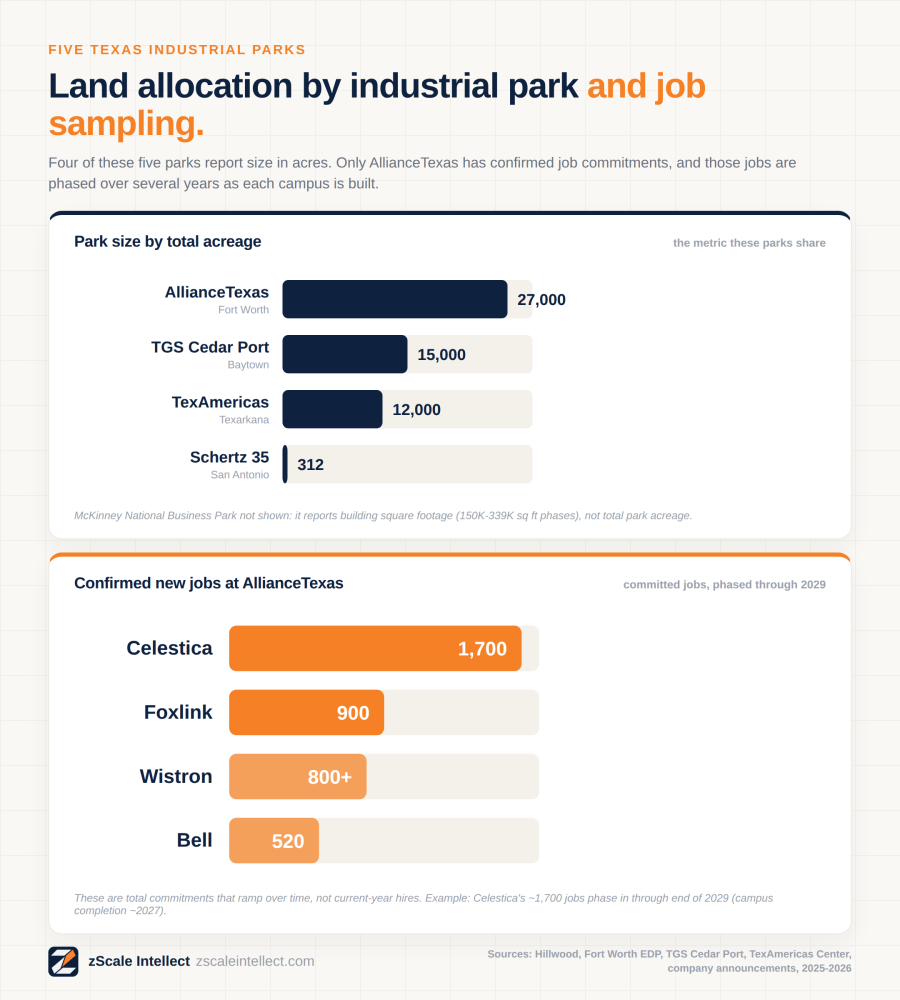
- AllianceTexas (Fort Worth / Hillwood) covers 27,000 acres with 602 companies and 73,134 direct jobs. Cumulative economic impact is $142.9 billion. The current build cycle includes Foxlink Group (147,780 sq ft, 900 jobs, production starting Aug 2026), Celestica (1M+ sq ft, approximately 1,700 AI-infrastructure assembly jobs) and Wistron (800+ jobs in AI supercomputer assembly). Fort Worth's Economic Development Partnership reported 11,000 new jobs and more than $10 billion in capital investment across the broader city in the past year.
- TGS Cedar Port (Baytown) is the largest rail-and-barge-served industrial park in the United States at 15,000 acres. Over 10,000 acres are still available. Rail capacity has expanded to 5,500+ railcars. If the manufacturing inquiry pattern holds at Cedar Port the way it is holding at AllianceTexas, those 10,000 open acres could represent 80,000-150,000 jobs of future workforce demand.
- McKinney National Business Park delivered Phase Two Buildings 400 and 500 (150K-339K sq ft) in 2025. CapRock Partners broke ground on a 15.3-acre, 250K sq ft McKinney Air Business Park in May 2026. McKinney's airport opens in Nov 2026. Available spec-shell space plus new air connectivity puts McKinney on the short list for advanced-manufacturing site selectors scanning north DFW.
- TexAmericas Center (Texarkana) ranked No. 5 nationally by Business Facilities in 2025 for the sixth straight year. The former Lone Star Army Ammunition Plant conversion into a 12,000-acre mixed-use industrial campus is one of the cleaner military-base reuse stories in the country.
- Schertz 35 (South Texas) sits on 312 acres along I-35 with a 197K sq ft spec-shell anchor building. Positioned between San Antonio's data-center buildout and the I-35 logistics spine running north to DFW.
What this means for workforce boards and community colleges
Each of these industrial parks faces a shared challenge when a manufacturing tenant signs a lease: sourcing 800 to 1,700 skilled technicians. Where are the 800 to 1,700 skilled technicians coming from?
The answer right now is community colleges and workforce boards entering the conversation at the site-selection stage. TWC's Skills Development Fund provides customized-training grants that are part of most EDC incentive packages. Tarrant County College is the closest CC system to AllianceTexas. Collin College serves the McKinney park. Lee College and San Jacinto College are adjacent to Cedar Port.
One of the main gaps I keep hearing about is how fast employers can fill these roles on such a tight timeline. For example, a manufacturer announces a 900-job facility with an 18-month construction window. The community college needs a mechatronics or CNC program producing graduates inside that same 18-month window. That timing gap is where workforce planning breaks down.
Underlying these five parks is a consistent foundation; the geography is unchanged, but the nature of the facilities and the required workforce preparation have undergone a fundamental shift.
For thirty years the Texas industrial park playbook was logistics. Sign a distribution tenant, fill a few jobs per acre, move on. That playbook is being rewritten in real time. When a manufacturer signs a lease, the region does not need dozens of workers. It needs hundreds of trained technicians, and it needs them inside an 18-month construction window.
That timeline is the real story. The capital moves fast. The buildings go up fast. The one thing that cannot be rushed is a mechatronics or CNC program that takes months to stand up and more months to graduate its first cohort. When those two clocks do not line up, the deal still closes, but the jobs get filled by workers imported from somewhere else, and the region loses the very benefit the incentive package was supposed to create.
The regions that win the next decade of advanced manufacturing will be the ones whose community colleges and workforce boards are in the room at the site-selection stage, not the ribbon-cutting. The Skills Development Fund is the tool. Tarrant County College, Collin College, Lee College, San Jacinto College and Texarkana College are the supply side. The question every one of these parks is asking is whether the training can move as fast as the concrete.
That is the gap worth closing. It is measurable, it is local, and it is the difference between a region that builds jobs and a region that just builds buildings.
If you lead a college or workforce board near one of these parks, I would like to hear how you are approaching the timing problem. Reply or reach out on LinkedIn.
About this newsletter
The Workforce Intelligence Brief is published every two weeks read for leaders building the workforce pipeline in the AI economy. Sushma Vadlamannati is Founder and CEO of zScale Intellect (d/b/a zScale Capital), a Dallas-based workforce-intelligence platform connecting colleges, EDCs and employers with verified labor-market data. zscaleintellect.com.
#WorkforceIntelligence #WorkforceDevelopment #EconomicDevelopment #TalentPipeline #HigherEducation #DFW